Who Am I?

Tuesday, May 26, 2015

Black Rat Snake

On the left side of this photo you can see a portion of the cleared fence row.
My oldest daughter is in the foreground.
My hardworking son is in the corner behind the brush pile on the left.
You can see his orange hat.
Recently my oldest boy has been on a clearing mission. After cutting down the brush from the copse of trees in the corner of the upper hay field, he attacked the Autumn Olives, Russian Olives, multi-flora roses, and other sundry creeping things along the fence row in the back corner of our property closest to our house. This resulted in several large piles of thorny brush about 6 feet high! We finally got these burned down this past weekend. (Below is one of them once it really got going and had burned down some.)


In the course of his destruction, my son disturbed a large, black rat snake. For as long as we have lived here, we have stumbled upon small snakes and large snake skins. We've found skins in the loft of the hay barn, next to the house, and in the woods. Once, as we were driving home, we saw a large Black Rat Snake coiled in the bushes along the wooded fence row that lines the drive. In this same fence row, although quite far away, he stumbled upon what is probably the same snake. It quickly slithered up a tree.  

If you look closely, you can see that the snake is wrapped around the tree.
Its head is in the Virginia creeper leaves on the left side of the tree.
He was wowed by the sight (of what he estimated to be a 6 foot long snake) and came running to tell me. I was an appreciative audience, but otherwise detained, so I sent him back with my phone to take some pictures.


The snake proceeded to coil around the tree, then climb further up and slip into a knot hole, as my son did his best to document.  Then is slipped back out again. 

As these photos show, rat snakes are able climbers. They can even scale brick walls with ease. And like many snakes, they are capable swimmers as well! When frightened, they often assume a kinked posture and remain motionless. They will supposedly vibrate their tail and expel a smelly musk too. Clearly this snake was not in the least bit intimidated by my son!


Black rat snakes primarily eat mice, rats, squirrels, and amphibians. They are constrictors. The local lore is that if you have a black rat snake near your home, it's means you're less likely to encounter a venomous snake, since they avoid each other's territory. I'm not quite sure if I believe that, but I have no problem being neighbors with a creature who is not only harmless to me and my children, but who helps to keep the rodent population in check.

However, rat snakes eat birds AND bird eggs. In fact, these snakes are a common predator of wood duck eggs. So I guess I won't bother to erect any wood duck houses by the lake, as I had considered. I am NOT fond of the fact that they mess with birds. I like birds. 

Friday, May 8, 2015

Persistent Predators

I obtained permission from our parish priest to haul away some aluminum awning frames that were no longer in use and were cluttering up the church yard. My plan is to make a portable chicken run. So far I have bolted the two together to make one long run and have contemplated my options.

These are the 2 awning frames, bolted together.
The day after I unloaded it from our pick-up I came downstairs after tucking our little ones in to find my husband staring at the fox. It was standing at 8:15, long before the sun had set, right next to the awning frames and staring at the chickens in their hoop house. He was just watching in fascination and disbelief, but I threw down the dirty diaper I was holding and ran out in my house shoes shouting and waving my arms. It looked at me approaching for a good few seconds before turning tail.


Since then I have had an animal trying to get into the hoop house. First the pop door was bent out of place. Then there was fur on the pop door, brownish red fur with longer guard hairs with a touch of black and white and fur on their elevated feeder. I promptly zip tied the pop-door at close intervals so that nothing could squeeze through. Then there were paw prints on the outside walls of the coop and a bent corner of the pop door. Then there was scratching and bare dirt beneath the pop door.

The "hoop house," tall enough to walk into, is on the left.
The top is covered in plastic to keep the rain off.
The door is still plastic-ed too, since we wrap the structure for the winter,
and I never bothered to unwrap the door.

Did you notice the cobwebs in the woven wire fence?
Did you see the tent caterpillar on top of it?
Perhaps it is a 'coon. We have one around the house all the time. I treed it in the crabapple tree just the other day. I think a fox would dig better than this animal has. Perhaps the fox will come back each night until it digs its way in. But the attached coop is so far proving to be impenetrable with its latches, straps, carabiners, and double-walls. I wonder how long they will last because life just isn't letting me get to the moveable chicken run creation.

Here's a pic. of the treed raccoon.

Thursday, April 9, 2015

Return of the Fox


The day after Hercules disappeared and the fox was seen rolling near the rooster's feathers, we saw the the fox again. The kids were eating their breakfast. I had gone upstairs for something. My oldest daughter came racing up the stairs to announce that, "That fox is out there again!" 


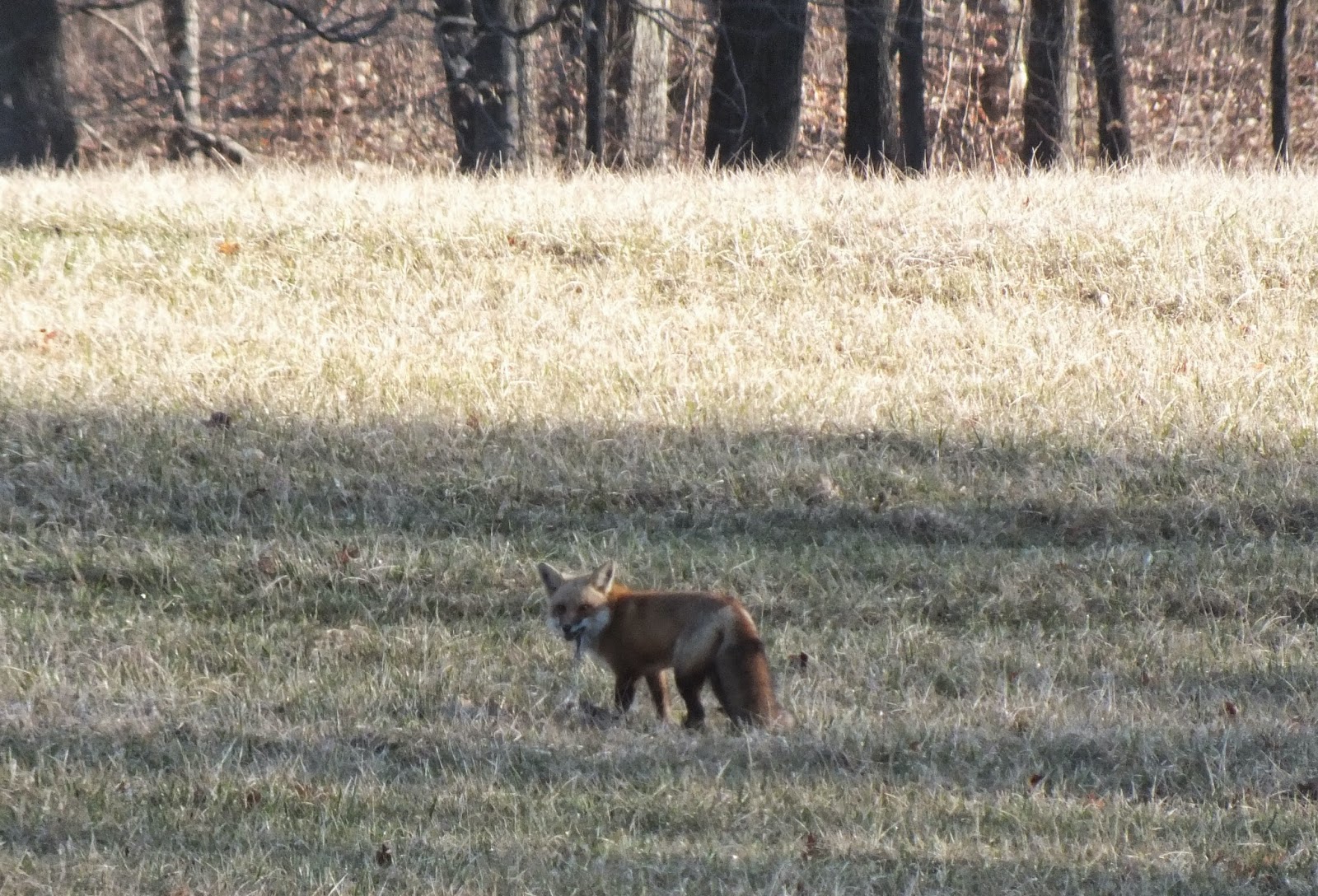
He was not in the same location as the day before, but further up the ridge and farther from our house, but he was in the middle of the hay field and he was clearly eating something. I snapped a few pictures from the master bathroom upstairs and from the dining room, in part because I have a small zoom lens on my camera and wanted to see if I could tell what he was eating, and partly from habit.


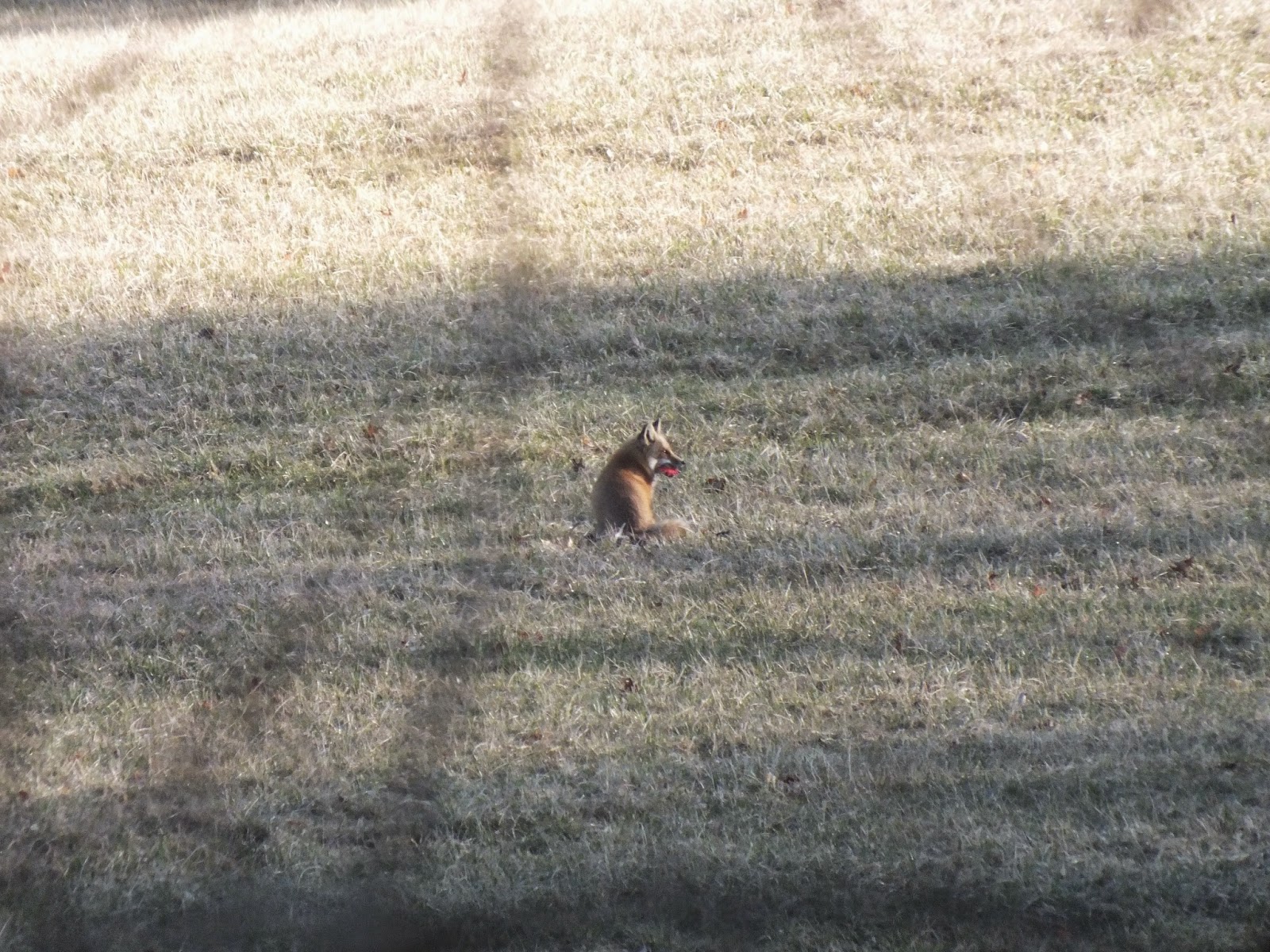
As he ate, turkey vultures soared and glided high over him and my children smudged the windows in order to gawk at him. He took his time, starting by standing over whatever it was and tearing it apart, and ending by sitting down with his back to the house, hunched up and munching. 


I kept thinking that I was seeing feathers, but he was awfully far away. Maybe I was imagining things. It was painful to watch him eat, even though his back was toward the house most of the time, because this time as I watched him, I wasn't just marveling at the wild thing so close. I wasn't spellbound by the unusualness or by his strange beauty. 


As the saying goes, I felt like my face was being rubbed in it, and I was mad about having to imprison my hens in chew-proof hardware cloth 24/7. Also, this time my children were thinking about a dead rooster being torn apart, and they weren't happy to see him either. So I felt badly also because of their indignant voices and sad faces.


When he was through, the fox trotted to the same "island of trees" in the hay field that he had disappeared into the day before. He didn't do any rolling in the grass or scratching this time. But he did lick his chops repeatedly (in seeming satisfaction.) And he did glance right at me before ducking into the copse of trees, as if to "thumb his nose" at me on his way by.


My head was full of questions. Had he killed the rooster for fun when he wasn't hungry and stashed him until the next morning? It was possible. Foxes have been known to do that. He couldn't have left his kill in the field or the turkey vultures and other vermin would have scavenged his leftovers. But why would he drag the carcass out into the open to eat it? Was he eating something else? Would we be seeing him regularly now? 


That very day my oldest son started clearing the bushes beneath the poplar trees where we had seen the fox retreat both days. He worked hard and fast, turning an oasis for wildlife into stumps and stacks of brush. He labored for an hour here and there for several days in thorny bushes and even during light rains, and I let him. 

Usually, I don't like clearing. I hate killing living things, even vegetation. But the fact that multiple coyotes could lurk so close to the kids, whose swing set was so near, disturbed me. The fact that dear, turkey, and squirrels also shelter there, means that it is probably crawling with ticks. And on at least one occasion, a stranger's truck had made the long trip up our driveway, turned around, and then paused for a long while out of sight behind those bushes doing who knows what before leaving. Also, the bushes were encroaching upon the hayfield. We lost more and more hay to them every year. It was even difficult to mow between them and the board fence last year.

Besides, the boy needed it. I think it was a way for him to deal with his grief, to hack away at the limbs of invasive species (autumn olives, Russian olives, and multi-flora roses) that grab his sleeves and tear his skin as he passes them on the mower. He's seen a lot of death in his short life... cats crushed under garage doors, cats so recently run over by vehicles that their tails were still twitching... Upon returning from vacation, years ago when he was still quite small, he ran to visit the chickens right away. He found one of our two hens dead from dehydration and overheating because the person we had arranged to let them out and feed them had neglected to do so while we were gone. During a game of hide-and-seek three years back he had found the young goat, Suzie Cubed, hanging dead from the high hay rack mounted on the stall wall. In some freak accident, she had managed to jump into it and to get her neck stuck between the bars as she struggled to get back out so that she broke her neck. And these are just some of the things I know about and remember. Rural life can be rough, the poor boy! 

Speaking of rough, I didn't venture out to see the remains of the fox's meal this time. I'm not that morbid. If it was Hercules, it was. And if it wasn't, it wasn't. The realities of farm living are hard on me sometimes too.

Tuesday, March 31, 2015

The Death of Hercules


Well, I had figured it would happen sometime. We have so many wild animals about that I'm surprised Hercules lived this long. But after months of roosting on the stall walls in the barn and roaming freely all day, announcing loudly and proudly his location, we had begun to think of him as a permanent fixture (see Hercules is Banished). One night, during evening prayers, my five year old even prayed that he would go away (see The Killer Roo). In fact, I almost advertised him on craigslist yesterday. 


But today he met his demise. Here's how it went down. It is a sunny day in the lower 60's. We were all sitting at lunch, and had the window open in order to hear the spring peepers, the wind, and to smell the spring soil. Suddenly, my seven year old stood up, pointed out the window and shouted, "I see a fox!"

If you look closely you will see Hercules' tail feathers sticking up from the hay to the foxes left.
So I walked to the window to take a look, and sure enough there was a fox in the hay field at about 12:30 pm rolling about...


and scratching. 


The children clamored at the window to get a better look at him. I retrieved my camera to snap a few photos, which I took through two panes of glass since the lower sash was raised. He seemed completely unaware of us. "Does he have hydrophobia?" I wondered aloud.


Eventually, he trotted over to the copse of trees in the hay field that lies just on the other side of the fence from the swing set. He did a turn and then ducked into the tangle of autumn olives, Russian olives, and multi-flora roses.


When I was looking at the fox through the lens of my camera earlier, I thought I had seen the legs of another animal in the air, so I scanned that area again with my camera to see if there were two foxes out there. Then it hit me. I hadn't seen the legs of another fox lying on its back in the hay. I had seen feathers! They were the long tail feathers of the seemingly invincible Hercules, stuck in the hay and waving in the wind!

With my 2 year old buckled back in his chair at the table and left with my sixteen year old, I went out to see if Hercules was still alive and in distress. All I found were three piles of feathers.... lots and lots of feathers, all seemingly black belly and tail feathers. I didn't see any white feathers at all, although there was some gray down. 


I took a quick turn through the barn and made sure the fox hadn't been digging about the chicken's hoop run, and to see if an injured Herc had returned home. But I saw no signs of digging or the rooster, and I returned to my waiting children. We decided that the fox must have been rolling about and scratching in order to remove the feathers from his coat. The kids think he took Hercules to the head of the little waterfall below the upper barn and ate him there, then trotted out to where we saw him in order to clean off. 

On one hand, I am relieved. The rooster had increasingly been a problem. He roamed all around the house, stalked my little boys, bothered my oldest when he fetched tools from the barn- And I'm glad that he went in a natural way, that my fed-up husband didn't have to dispatch him. But on the other hand, I am sort of sad too. It has been nearly a year that we've had him. I will miss his entertaining roosterish antics, if not his boisterous crowing or his fearsome foot fetish. 


He had a fantastic strut, 


the tallest comb, 

Here is his comb after roughing it in the barn, You can see the effects of frostbite. 


and the most glorious black, iridescent, and flowing tail feathers.


Now I definitely know what was taking my chickens last fall before I imprisoned them. If that fox took the meanest rooster at midday, then it surely could have taken Rusty the rooster or the other four hens who went missing. And it means I will never ever be able to let my girls roam freely. It also means that the lightweight, moveable run with aviary netting that I was thinking of building for the summer is out of the question. Foxes can even chew through chicken wire and most hardware cloth, the stinkers.  

Friday, March 6, 2015

Snowbird


A male robin has been frequenting the crabapple tree behind our house. 

This is what he looked like when he first showed up in January.
He clumsily eats crabapples when the grass is covered with snow 
(as it most often is.)


 When it is cold, he puffs himself up and hunkers down in the sun.


He chases off the white-breasted nuthatches, 
the black-capped chickadees, 
and the downy or hairy woodpeckers when he is near.  
And I've even seen him drive off another male robin.


 I'm not sure when he showed up, 
but since his favorite tree is right outside of our dining room, 
we see him a lot. 
I snapped my first picture of him in the middle of January. 


He doesn't sleep in the tree. 
Some days I never notice him out there. 
Some days he seems to be there all day. 
I'm hoping he has pegged the tree for a nesting site, 
but male robbins don't build nests, 
so perhaps the tree is just one of the look-out posts for his territory. 


Female robins are supposed to follow the males by only a few weeks, 
but although I've seen a flock of robins in the yard on one occasion 
since "our" robins arrival, 
none of them stayed. 


Perhaps the snow on the ground had something to do with that. 


Despite the thick blanket of snow outside, 
spring is definitely "just around the corner."
Our daffodils showed their green, spiky tops last December!


Already the days are longer 
and I must trudge out to the chicken coop earlier and earlier in the morning,
and I close the chickens up later and later each evening.
Already the moon rises big and round behind the barn 
instead of slipping up between the trees in the woods.


I long to hear the trilling of sandhill cranes as they fly over. 


I enjoy the honk of Canada geese down on the pond.


I like the loud chirping of incalculable spring peepers
and the return of birdsong.
I love spring flowers


But I do not look forward 
to the mucky swamp that our lawn will be when it thaws-
and my children will be clamoring to romp in it.
I do not look forward to the return of ticks.
The weeds, autumn olives, multiflora roses, and wild raspberries will take over again.
The tentacles of poison ivy will creep into the "yard."
And all too soon, mowing will begin again.


So I am satisfied to see small signs of spring, 
like "our" robin,
but I have no desire to hurry it along.