Who Am I?

Tuesday, August 4, 2015

Painless


Every year, haying has been awful. When we were unloading the moving truck on the day we moved in, we were approached by a couple of neighbors who offered to cut our hay. Being honest people ourselves, and knowing that these people were our new neighbors, we didn't think to ask for references in order make a choice based on skills, etc. We just gave the job to the first folks who asked. It seemed fair at the time. We've regretted it ever since.


The job went to our neighbors across the road (and their extended family.) To us, "neighbor" means that they are about ¼ of a mile away "as the crow flies." From the start, they acted a little too freely with our land and a little bit rudely. To start off with, one of them would drive over in his truck or "go buggie," as he called it, without calling first, and park at the end of our sidewalk. Then he would honk until I came out. Often I was cooking dinner or tending a baby. And the whole time I chatted at the end of the walk, my kids would be unattended. This annoyed me greatly, and he was never apologetic about it, but I learned that he had emphysema, so I forgave the inconvenience and impropriety and acted as though this were a perfectly normal thing to do.


Also,  he or another one of them, would come over and drive through our fields unannounced in their all-terrain vehicle, crushing the hay and leaving gates open, sometimes weeks in advance of haying. One of us would hear the noise and see them through the window. They wouldn't even drive on the mowed paths! Then there was the fact that they would show up to hay without calling first most times. Also, they would cut and leave parts undone without consulting with us. They would leave their round bales on the fields a long time, so that they killed spots and so that they tore up the newly growing hay when they finally came to haul them off. They even left their machinery parked in our  hay fields. And this was just the tip of the iceberg.


Our neighbors weren't timely. Every year but one, our "first cutting" was done too late. Because of this we went multiple years with only one cutting, even when no inclement weather made cutting difficult. This was bad for our hay crop as it was always past prime. It also allowed for weeds to seed themselves. It was also bad for our pocketbooks. It cut our profit in half. 

They were wishy washy about when they would start too. We'd try to nail them down about what day they would cut and often they'd tell us something that didn't turn out to be correct. And they'd cancel on us once arrangements had been made sometimes as well. Once they called us to cancel cutting the next day because it was "supposed to rain." The chance was only 3%! What do you say to that?! And, they made the decisions about when to cut without consulting us.


One year they came to us after we had been stewing all summer about it not being cut and told us that they decided that they weren't cutting it that year! My husband put his foot down and made them cut and bale it anyway, despite the hay being practically worthless. He informed them that they cut it this year or they never cut it again. In order to placate us, they promised we’d be the first field they cut the next year. Of course, they didn't cut our field first. In fact the year after that they didn't either. They recruited a new field and put it in the rotation before ours!

Our neighbors weren't good at drying the hay. They never left it in the field long enough. They never let it sit long enough after raking it. They tried to cut the evening of one day, let it sit the next, rake it in the middle of the third, and bale it right after raking it. Given this short time span, the usual high humidity here, and the heavy dews that are standard, often the hay they baled was too wet and green. We had to cure bales under our gazebo and such for fear of spontaneous combustion causing our barn to go up in smoke. And sometimes the bales would mold because of the moisture too.


Our neighbors weren't good at baling either. Every year untied or broken bales were left on the field after they drove off and before we ever touched them. Many of the square bales that were tied were too loose to stack in the truck, pitch into the barn, or stack in the loft. Usually one strand of twine was tight and the other was loose. This meant that they exploded to bits easily. Even if we managed to baby the bales in order to get them stored away, the twine broke frequently when someone shifted them from the hay barn.

Here's part of a stack of loosely baled hay from a previous year.
Our neighbors park their baler out in the field all year and I think the twine had partially rotted, but they didn't want to replace it. My son reported that they had two different diameters of twine strung so that the tension would always be off on one side. It made it awfully hard to sell our hay, so we were lucky when another neighbor got three horses and would buy our sad bales from us at a discounted price, coming to get them one at a time as she needed them. I estimate that we lost about 1/5 of the hay just to bad baling! 

Our neighbors had trouble with their round bales too, sometimes dropping an unwrapped bale on the field. On one occasion when this happened, one of them was rather ineffectively ramming the hay with their ATV in an attempt to spread out the hay so that the baler could drive over it again. (They never re-baled our broken square bales.) My hardworking and thoughtful oldest son grabbed a rake and went out to help. As soon as he showed up, they left him to spread out an entire giant round bale that was taller than he was, all by himself. They just drove off! 

Our neighbors were obviously not hard workers. Every year we had issues with what they cut and how they cut it. There would be strips of un-mown hay left standing in the field, and they would leave sections of the field uncut. They would refuse to do the pasture behind the barn unless we REALLY pushed them, and they never mowed inside the unused riding ring. One time they just argued about it, saying it was too hard to maneuver in that shape of field. Another year they just lied; they told us they couldn't get their equipment into the riding ring, even though the gate to it is the same size as the one to the other fields. After three summers, they pretended they didn't know what to cut even though we asked them every single year to cut certain parts that they always tried to leave uncut. We never understood how they could be in doubt or why they didn't just ask if they were. Then when we brought it up, they acted like it was too late to cut those parts. And in the end, they were just shortchanging themselves! They were cutting into their own profit. In fact, one hard winter they bought hay from us (which we sold to them for a pittance) because they hadn't put up enough to get their cattle through a long winter. It was mind-boggling.

And every year the interactions got worse. Once they just horned into the hay barn and pretended  to help us stack bales just so that they could count how many bales we put up, and how many bales our neighbor who rents barn space from us put up. (They cut her hay too.) They never helped us load, pitch or stack hay at any other time. Then they tried to get her to give them part of her portion of hay, claiming they were shortchanged. My husband did the math and it turned out they got more than their fair share. Once they pushed us on fertilizer (to increase yield and control weeds they said) even though they didn’t cut at peak protein content or to prevent weed heading. Heck, they didn't even cut twice a year- which was bad for the hay but also, really just robbing themselves of income. In addition, they took a little more of our portion of hay every year. (Our agreement was that we gave them ⅔ of the crop in exchange for cutting and baling.) 

The breaking point came when they made a deal with one of our steady hay customers, the one who rents hay storage space in our barn, to sell to her square bales off of our field cheaper than she buys it from us (because when you buy off of the field you do the lifting, hauling, and storing of the hay, so is discounted.) The previous situation was that they square baled our share and round baled theirs. The stinky thing was, that not only did they steal our customer and try to get us to put up their hay (because we swap haying labor with this customer neighbor) but they left a large section of one of the main fields uncut and shorted us a large portion of our hay, without even bothering to inform us. In trying to talk this last bit through with them, they informed my husband that they had more hay than they needed, even though we knew they took on a new field that year from some other neighbors. Even though we didn't have more than WE needed. When my husband got a little frustrated with them, one of them suggested that we find someone else to cut our hay and insinuated that we couldn't find anyone to do it better. So, this year we did arrange to have someone else cut and bale our hay!


We had been so unhappy with them for so long, but put up with it all for the sake of neighborliness and peace. Every year I talked to my husband about how we should really get someone else to cut our hay. Every year, big-hearted man that he is, he convinced me to give them another chance. We even let them run their cattle on our fields for next-to-nothing during a drought. We sold them hay for a song when they ran out of fodder. We helped them multiple times when their cows and horses got out. We gave them "the benefit of the doubt" for years! The more generous and understanding we were, the more belligerent they got, and the more they took advantage. They must have thought that we were stupid? Maybe they thought we were know-nothing, rich, "city slickers?" I don't know. It makes me sad that our patience and generosity was met with the treatment they gave us.


We still send them Christmas cards. We still wave when we go by their place. We still work hard not to run over their dogs that dart out at our car when we drive by. My son still mows their yard for next to nothing. But, this year we got a neighbor who lives a little further away to cut our hay. Three people recommended him to us. He was communicative, speaking to my husband on the phone several times before cutting. He was punctual. He showed up when he said he would. He did a good job cutting. There were no unmown strips. He cut the riding ring, the pasture behind the pole barn, AND all parts of the other fields without being pushed to do so. He baled right when he predicted, and the bales were dry and tight. He didn't leave any machinery parked around for days. He removed his round bales from our field early the morning after haying. AND, he gave us more than the agreed upon share of hay. The whole process was peaceful and painless, just like it should be. 

Saturday, August 1, 2015

Dew Jewels

It was a long, wet May, June, and July. Mostly, I got pretty grumpy about it. The kids got cabin fever. The chickens made a mess of the ground beneath their run right away no matter how fast I moved it; they tracked mud onto their eggs. The haying was postponed later and later, and the hay was beyond its prime. It was beaten down again and again. Mowing was difficult, and I was tired of picking up branches and having raging bonfires that were hard to start...

But one morning, when the rain wasn't falling, I grabbed my camera and swerved past the hay field on my way to the barn. Despite the overcast sky, the gray day, the nightly rain had left a sparkling, beaded coating on the bent and battered hay. Tiny orbs, small magnifying glasses, trembled in strings up each stalk and along each blade. They clung in clusters on the clover's cradling, cupped, leaves. I only had a few minutes to crouch in the saturated, grass and snap pictures from one or two vantage points, but those few minutes really made my day. How I would have loved to have spent and hour or two!

Here are some of my pictures from that morning. 


Do you find them as enchanting as I do?

Thursday, July 16, 2015

Barn Cats

Ferral cats and litters of kittens seem to be commonplace on farms. I suppose some folks get a cat or two to help control rodents. And, I also suppose that some folks attract cats because of their rodent problems. We've never had any cats around until about a year ago. The folks building a house on the plot of land next to us seem to have some. Ever since they parked a trailer there to live in while they build, I have spied a couple cats on our property now and then. This irked me, because cats are the single largest predator of songbirds, especially those that nest low, like bluebirds. And as you know from reading this blog, I love birds, and have a soft spot for eastern bluebirds in particular.


Anyway, one morning when tending the animals, Lily, our goat, acted strangely. I opened the stall door inside the barn and instead of cantering out as usual, she stayed in a corner of her stall and acted fearful. I poked around her stall and saw nothing amiss. So I went over to the stanchion and dropped a handful of feed into the food tray, as usual. She didn't come. That was a first. So I wandered back out into the barn, thinking and observing.

Eventually, I heard a soft mew. Cats! Upon investigation, I discovered six gray kittens. The goat was terrified of them! When the kittens ran into the far corner of the barn, unsure of me, Lily saw her chance. She bolted outside as quickly as she could and didn't touch her feed.


This went on for a day or two. I even had to forcibly push Lily into her stall at night. Things were coming to a climax. My oldest son and I discussed trapping and rehoming them. We decided to wait until my husband returned from his business trip before taking any action. He came home and gave the things some water and asked on FB if anyone needed a kitten! 


So, I started looking into free spay and neuter clinics, thinking that they'd stay after all. They were, admittedly, cute, and two of my kids liked them too. Then one morning all of the kittens were gone. I'm not sure if the fox got them one night, or if the mother came and carried them off one by one upon learning that our barn was trafficked more than she liked. Personally, due to my being allergic, the goat's terror of her, the damage they would do to the bird population, and the hassle they would cause, I was relieved. 

Interestingly enough, our old goat, Annie, gentle creature that she was, detested cats. On the few occasions she was exposed to them, she butted and rammed them. She chased them and stamped! This was so very unlike her nature, she who patiently let the kids torment her. We were always astounded and mildly amused, and had assumed that she had had the bad experience in the past of being pestered by a cat when she was in milk or something. But perhaps it's a common trait in goats. I'll have to investigate this theory. 

Wednesday, July 15, 2015

Jack in the Pulpit


Since much of our land is wooded, 
we have many varieties of Jack in the Pulpit here on the homestead. 


This year, they flourished because it was so wet. 


All of these were growing along the back woods, 
next to the gravel driveway to the pole barn.


While I have taken time to note them in in the past, 
this year I happened to notice them after the spathe (pulpit) 
and flower on the spadix (Jack) had withered. 


What is left behind are masses of shiny, green berries.


I'd never noticed the berries before, as I typically hike in the spring and the fall 
in order to avoid poison ivy, stinging nettles, and the worst of the tick season,
and because my twice-daily trek to the barn is usually across the grass and not along the drive. 


I looked up Jack in the Pulpits and learned that the seeds will turn red in the late fall. 

Now I am tempted to collect them and grow some plants from seed. Although I also learned that it takes 3 years for the plants to form a bloom, and I'm not sure that I want to invest that much time before most folks could even tell that they were Jack in the Pulpits. It would just be easier and more effective to dig up the corms of the ones along the woods and transfer them to where I want them, assuming they can survive transplanting. (Corms are sort of like bulbs. Crocus have them.) I've never seen Jack in the Pulpits in anyone's flowerbed before, so I might go for it. Since we tore out the decrepit bushes that ran along the front of the house, we are in need of some plantings there anyway.

Tuesday, July 14, 2015

Chicken "Tractor"


the view of the baby gate doors, and the wheels on extended arms
I have finally completed the previously mentioned "chicken tractor." To those who are not experienced with raising chickens, a chicken tractor is a moveable chicken run that protects hens from predators, while at the same time allows them to range on new grass as it is moved. Some people move them with tractors, hence their name, I guess.


I started out with 15 birds about a year ago, and let them free range for a time. I am down to 6 now. Predators have taken their toll, despite a shelter for them to run into with a tiny pop door that I closed at night, a 5 foot tall fence around that, and multiple roosters to raise the alarm and protect their hens, and a "guard goat." All birds were taken during daylight hours; my nighttime setup worked well.


the semi-stationary hoop house behind the fence
Since I have a relatively stationary hoop-house run made out of cattle panels bent into a 2 x 4 frame, covered with ¼ inch hardware cloth, and attached to a double-walled manufactured chicken coop on wheels that works well for the winter, my goal was to make a moveable summer shelter for my hens. I wanted to be able to move it by myself and truck it along the woods, the hay field, or in the yard, depending upon my schedule and where insect and vegetation control was needed.


the two awning frames bolted together
My plan came together after acquiring two aluminum frames from half-circle awnings that my parish was no longer using. I bolted them together end-to-end with the brackets that had been previously used to attach them to the building. Then I wrapped the curved top part in ½ inch, 19 gauge, galvanized, welded wire hardware cloth one section at a time by stretching the wire and attaching the edges to the frame with zip ties. (This mesh should keep out everything but rodents, which I am not concerned about because of the frequent relocation of the coop.)


the tractor completely wrapped except for the door end,
along with the failed rope handle
the wheel arms attached with pipe strapping 
After each top section was attached, I attached the bottom panel. (I need these to keep out digging animals.) This meant that I rolled the frames over a lot. For the bottom I used a larger gauge and larger opening of 2x3 inches so that the hens could scratch, eat greens, and find insects. On one end, I attached 2 x 4s that I scavenged from the 
barn to the outside to extend wheels off of the end.  This would give me ground clearance when rolling the run about. I did this from the inside with plumbing strapping so that the screws could go through the holes in the wire mesh and not hurt the integrity of the hardware cloth. I also drove a screw through the wood from the outside of each board into the aluminum frame to keep the board from flexing too much as the hoops increased in weight. To the 2x4s I attached leftover sections of landscape timbers so as to keep the wheels from rubbing on the extension bars. Through these two pieces of wood I drilled a hole though which to run a bolt that would act as an axle. On these bolts I slipped wheels that had been left in the barn by previous owners, stabilizing them with large washers left over from another project.


the wheel extensions
After the wheels were completed, I wired up the end without the wheels. Inside the other end I rigged up two levels of roosting bars by using old wooden fence stakes that I oiled (to discourage mites) parts of a broken Swiffer Sweeper handle, a discarded extension rod, and of course.... more cable ties! In the corners on the same end as the roosts I attached old plastic wash tubs collected from the barn to the frame with more zip ties. I found steel S hooks from which to hang the feeder and waterer that had once been part of a pot rack at our old home. I put the coop-type items on this end so that the heavier items would be closer to the weight-bearing wheels. 

the roosts under the tarped end by the doors
After that coop section was squared away, I used two panels from a discarded wooden-framed baby gate that I dismantled for doors- after coating them with hardware cloth. I had to add a frame along the edge to keep animals from prying the door from the wire wall. I added little latches and carabiners to the door corners and framing to keep the doors securely closed and safe from raccoon paws. I wrapped the portion above the door with leftover heavy-duty plastic sheeting, along with the sides next to the door. This should keep the end of the taller roost and the nest boxes dry during driving rains. Finally, I attached tarps to cover half of the top for sun and rain protection purposes.  

Carabiners are key to foiling 'coons.
These latches are at the door
corners to prevent prying.
The baby gate measurements
are like the convenience
store door frames- ha!
That left me to come up with the handle for the "tractor." I tried a rope tied onto the frame at first. It stretched and cut into my hands. It also stayed wet- yuck! Now I am using plastic chain (for reduced weight) that I had leftover from hanging plants or our farm sign or something, run through a used piece of plastic plumbing pipe from our broken sink drain (to save my hands from the chain cutting into them) and attached them with old swing hangers. This works better, but I need a stronger piece of pipe, perhaps PVC, for the plastic pipe has already cracked from the weight of the coop. 

The chain and pipe handle are also on in this picture.
Since the thing took so long to build between my husband's trips, our field trips, the excessive rain this season, and the short bursts of time allowed me by the children, I moved the hens into their new quarters only a little over a week ago. Since then I have been training my birds where to lay their eggs and where to roost. One bird wanted to sleep in one of the nest boxes, but after manually placing her on the roost at night she started going there herself after a time or two. And I still get the random egg laid on the ground (which is a huge pain) but more are being laid in the nest boxes each day.

The coop is necessarily on the heavy side due to all of the wire mesh and its length. With the handle strung tightly along the lower frame edge, I can barely lift that side and roll the coop. Usually I will only be moving it the length of the coop, so this should work for me. My problem right now is when and how to move the run. I have to move it at night after the birds have roosted.  I haven't been brave enough to try it during the day when they are all running around for fear of hurting legs. The floor grating has large holes so that they can scratch, and I'm worried about a bird getting dragged or getting a leg stuck. Hopefully I will figure this out soon! I have read about others with wire bottomed chicken tractors whose hens simply hop up onto the wires when it is lifted for moving.

I was looking forward to completing this and having a sense of accomplishment. As a mom, whose duties are never-ending, finishing something would be a welcome novelty. Since most of the summer is gone and collecting eggs so low to the ground is a pain (as is hanging the waterer and feeder) there has been a bit of a let-down for me. Plus, the seeming never-ending rain has made everything the consistency of a sopping wet sponge, so the new turf the chickens get isn't quite as desirable as I had envisioned, and the tarp is trapping buffalo gnats underneath.

On the plus side, the hens can now hop down at the crack of dawn and scratch about without waiting for me to let them out of their coop into their semi-stationary run. They have about twice the square footage to roam in too. Hopefully this means that there will be less feather-picking. And, from the dents on top of the tractor, it looks as though the seams are strong enough to keep out raccoons. Finally, it also means that I can be home after dusk without risking the loss of a bird. That is pretty huge too. Plus, I can console myself that I only purchased cable ties (about 1700 of them) 4 carabiners, 2 bolts, 2 tarps, hardware cloth, tile board edging, and a metal rod. I also found a good use for a discarded baby gate, 2 beat up plastic wash tubs, 2 fence posts, 2 aluminum awning frames, 2 wheels that were rusting in the barn, 2 left over washers, old siding screws, discarded plumber's strapping, unused latches, old pot hanger hooks, remaining plastic chain, old plastic plumbing, a broken sweeper handle, an extension shower rod, and left over plastic sheeting. 

Tuesday, May 26, 2015

Black Rat Snake

On the left side of this photo you can see a portion of the cleared fence row.
My oldest daughter is in the foreground.
My hardworking son is in the corner behind the brush pile on the left.
You can see his orange hat.
Recently my oldest boy has been on a clearing mission. After cutting down the brush from the copse of trees in the corner of the upper hay field, he attacked the Autumn Olives, Russian Olives, multi-flora roses, and other sundry creeping things along the fence row in the back corner of our property closest to our house. This resulted in several large piles of thorny brush about 6 feet high! We finally got these burned down this past weekend. (Below is one of them once it really got going and had burned down some.)


In the course of his destruction, my son disturbed a large, black rat snake. For as long as we have lived here, we have stumbled upon small snakes and large snake skins. We've found skins in the loft of the hay barn, next to the house, and in the woods. Once, as we were driving home, we saw a large Black Rat Snake coiled in the bushes along the wooded fence row that lines the drive. In this same fence row, although quite far away, he stumbled upon what is probably the same snake. It quickly slithered up a tree.  

If you look closely, you can see that the snake is wrapped around the tree.
Its head is in the Virginia creeper leaves on the left side of the tree.
He was wowed by the sight (of what he estimated to be a 6 foot long snake) and came running to tell me. I was an appreciative audience, but otherwise detained, so I sent him back with my phone to take some pictures.


The snake proceeded to coil around the tree, then climb further up and slip into a knot hole, as my son did his best to document.  Then is slipped back out again. 

As these photos show, rat snakes are able climbers. They can even scale brick walls with ease. And like many snakes, they are capable swimmers as well! When frightened, they often assume a kinked posture and remain motionless. They will supposedly vibrate their tail and expel a smelly musk too. Clearly this snake was not in the least bit intimidated by my son!


Black rat snakes primarily eat mice, rats, squirrels, and amphibians. They are constrictors. The local lore is that if you have a black rat snake near your home, it's means you're less likely to encounter a venomous snake, since they avoid each other's territory. I'm not quite sure if I believe that, but I have no problem being neighbors with a creature who is not only harmless to me and my children, but who helps to keep the rodent population in check.

However, rat snakes eat birds AND bird eggs. In fact, these snakes are a common predator of wood duck eggs. So I guess I won't bother to erect any wood duck houses by the lake, as I had considered. I am NOT fond of the fact that they mess with birds. I like birds. 

Friday, May 8, 2015

Persistent Predators

I obtained permission from our parish priest to haul away some aluminum awning frames that were no longer in use and were cluttering up the church yard. My plan is to make a portable chicken run. So far I have bolted the two together to make one long run and have contemplated my options.

These are the 2 awning frames, bolted together.
The day after I unloaded it from our pick-up I came downstairs after tucking our little ones in to find my husband staring at the fox. It was standing at 8:15, long before the sun had set, right next to the awning frames and staring at the chickens in their hoop house. He was just watching in fascination and disbelief, but I threw down the dirty diaper I was holding and ran out in my house shoes shouting and waving my arms. It looked at me approaching for a good few seconds before turning tail.


Since then I have had an animal trying to get into the hoop house. First the pop door was bent out of place. Then there was fur on the pop door, brownish red fur with longer guard hairs with a touch of black and white and fur on their elevated feeder. I promptly zip tied the pop-door at close intervals so that nothing could squeeze through. Then there were paw prints on the outside walls of the coop and a bent corner of the pop door. Then there was scratching and bare dirt beneath the pop door.

The "hoop house," tall enough to walk into, is on the left.
The top is covered in plastic to keep the rain off.
The door is still plastic-ed too, since we wrap the structure for the winter,
and I never bothered to unwrap the door.

Did you notice the cobwebs in the woven wire fence?
Did you see the tent caterpillar on top of it?
Perhaps it is a 'coon. We have one around the house all the time. I treed it in the crabapple tree just the other day. I think a fox would dig better than this animal has. Perhaps the fox will come back each night until it digs its way in. But the attached coop is so far proving to be impenetrable with its latches, straps, carabiners, and double-walls. I wonder how long they will last because life just isn't letting me get to the moveable chicken run creation.

Here's a pic. of the treed raccoon.

Thursday, April 9, 2015

Return of the Fox


The day after Hercules disappeared and the fox was seen rolling near the rooster's feathers, we saw the the fox again. The kids were eating their breakfast. I had gone upstairs for something. My oldest daughter came racing up the stairs to announce that, "That fox is out there again!" 


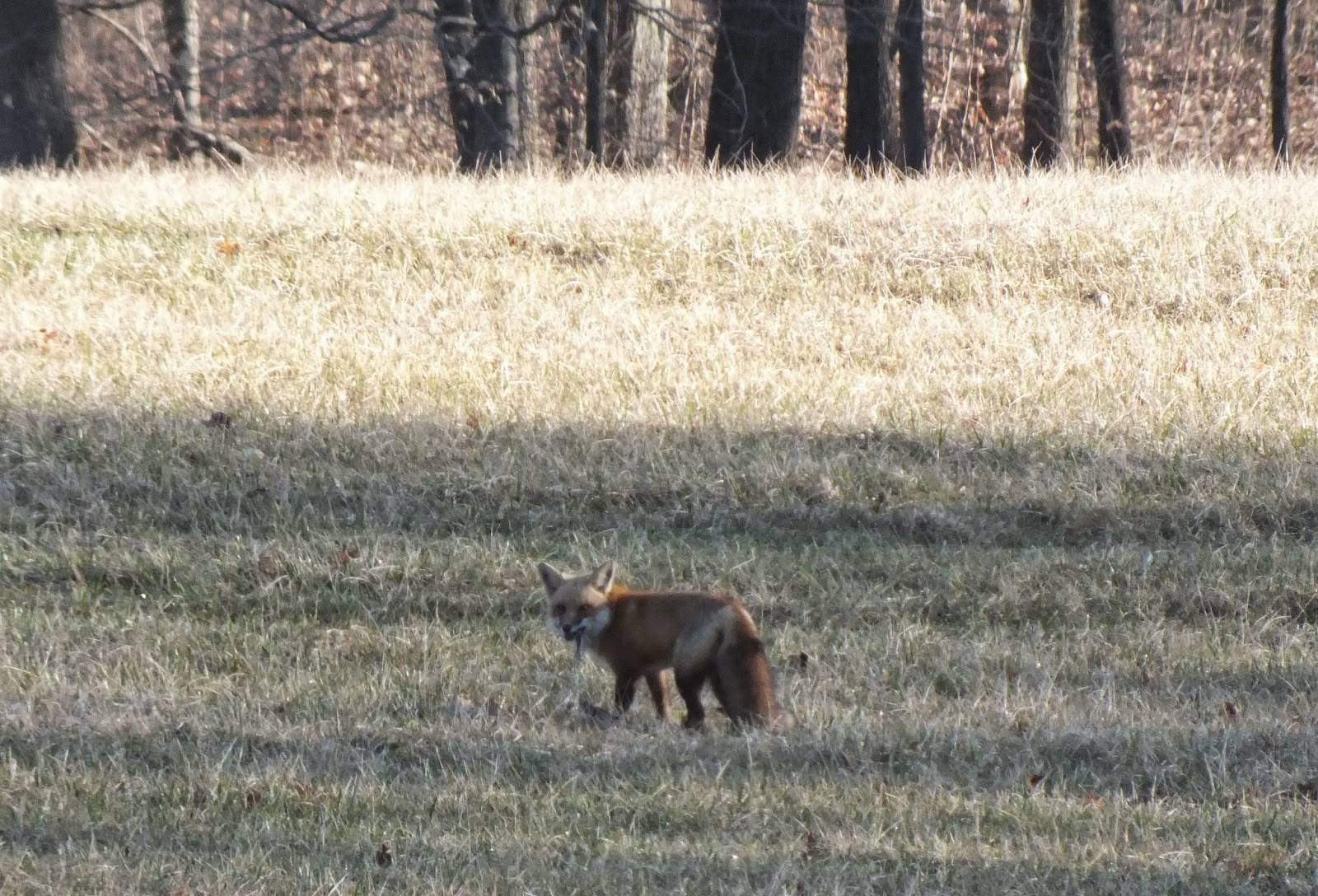
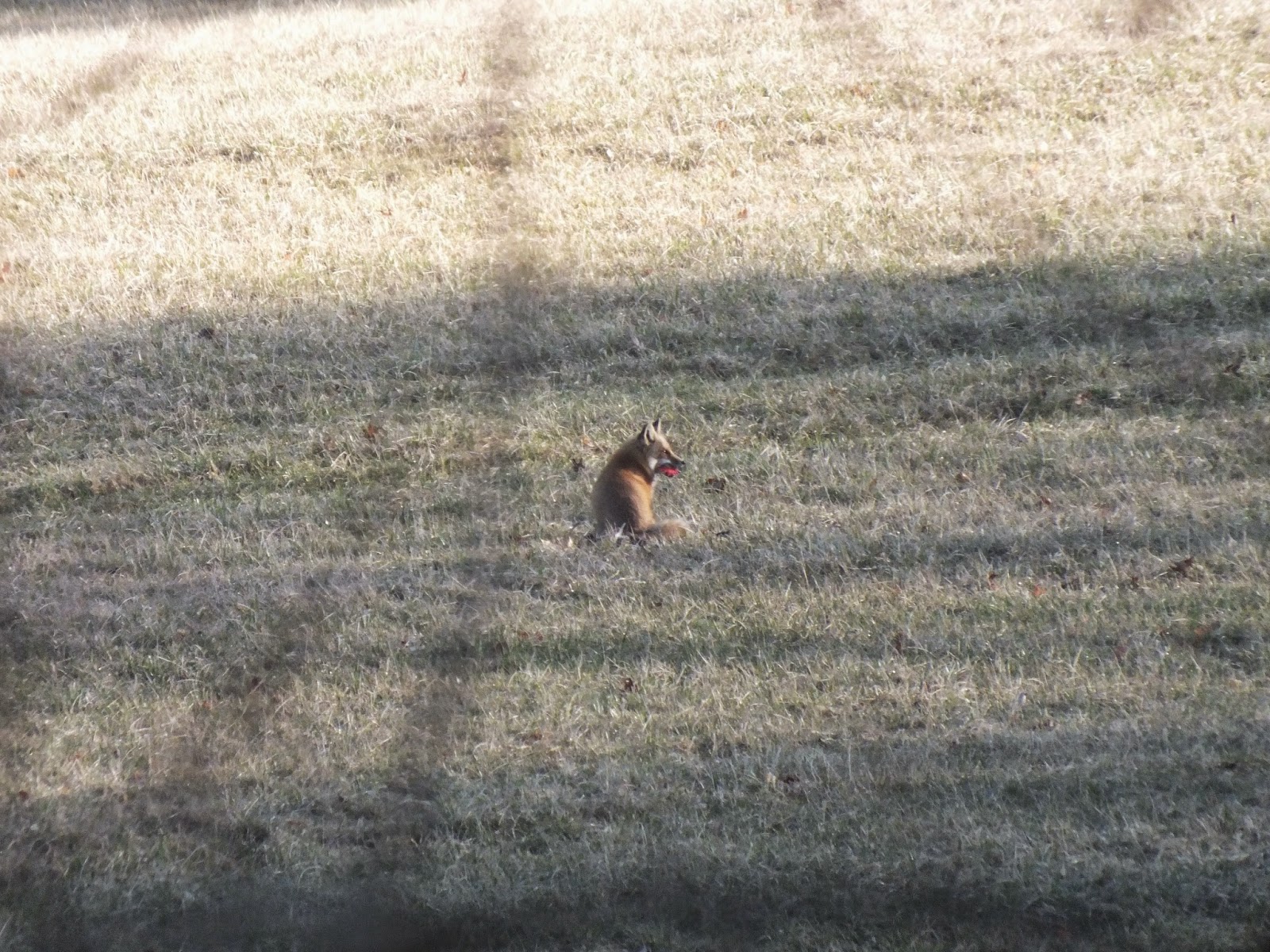
He was not in the same location as the day before, but further up the ridge and farther from our house, but he was in the middle of the hay field and he was clearly eating something. I snapped a few pictures from the master bathroom upstairs and from the dining room, in part because I have a small zoom lens on my camera and wanted to see if I could tell what he was eating, and partly from habit.


As he ate, turkey vultures soared and glided high over him and my children smudged the windows in order to gawk at him. He took his time, starting by standing over whatever it was and tearing it apart, and ending by sitting down with his back to the house, hunched up and munching. 


I kept thinking that I was seeing feathers, but he was awfully far away. Maybe I was imagining things. It was painful to watch him eat, even though his back was toward the house most of the time, because this time as I watched him, I wasn't just marveling at the wild thing so close. I wasn't spellbound by the unusualness or by his strange beauty. 


As the saying goes, I felt like my face was being rubbed in it, and I was mad about having to imprison my hens in chew-proof hardware cloth 24/7. Also, this time my children were thinking about a dead rooster being torn apart, and they weren't happy to see him either. So I felt badly also because of their indignant voices and sad faces.


When he was through, the fox trotted to the same "island of trees" in the hay field that he had disappeared into the day before. He didn't do any rolling in the grass or scratching this time. But he did lick his chops repeatedly (in seeming satisfaction.) And he did glance right at me before ducking into the copse of trees, as if to "thumb his nose" at me on his way by.


My head was full of questions. Had he killed the rooster for fun when he wasn't hungry and stashed him until the next morning? It was possible. Foxes have been known to do that. He couldn't have left his kill in the field or the turkey vultures and other vermin would have scavenged his leftovers. But why would he drag the carcass out into the open to eat it? Was he eating something else? Would we be seeing him regularly now? 


That very day my oldest son started clearing the bushes beneath the poplar trees where we had seen the fox retreat both days. He worked hard and fast, turning an oasis for wildlife into stumps and stacks of brush. He labored for an hour here and there for several days in thorny bushes and even during light rains, and I let him. 

Usually, I don't like clearing. I hate killing living things, even vegetation. But the fact that multiple coyotes could lurk so close to the kids, whose swing set was so near, disturbed me. The fact that dear, turkey, and squirrels also shelter there, means that it is probably crawling with ticks. And on at least one occasion, a stranger's truck had made the long trip up our driveway, turned around, and then paused for a long while out of sight behind those bushes doing who knows what before leaving. Also, the bushes were encroaching upon the hayfield. We lost more and more hay to them every year. It was even difficult to mow between them and the board fence last year.

Besides, the boy needed it. I think it was a way for him to deal with his grief, to hack away at the limbs of invasive species (autumn olives, Russian olives, and multi-flora roses) that grab his sleeves and tear his skin as he passes them on the mower. He's seen a lot of death in his short life... cats crushed under garage doors, cats so recently run over by vehicles that their tails were still twitching... Upon returning from vacation, years ago when he was still quite small, he ran to visit the chickens right away. He found one of our two hens dead from dehydration and overheating because the person we had arranged to let them out and feed them had neglected to do so while we were gone. During a game of hide-and-seek three years back he had found the young goat, Suzie Cubed, hanging dead from the high hay rack mounted on the stall wall. In some freak accident, she had managed to jump into it and to get her neck stuck between the bars as she struggled to get back out so that she broke her neck. And these are just some of the things I know about and remember. Rural life can be rough, the poor boy! 

Speaking of rough, I didn't venture out to see the remains of the fox's meal this time. I'm not that morbid. If it was Hercules, it was. And if it wasn't, it wasn't. The realities of farm living are hard on me sometimes too.